
AI in Solar Energy: How AI Improves Efficiency and Scale
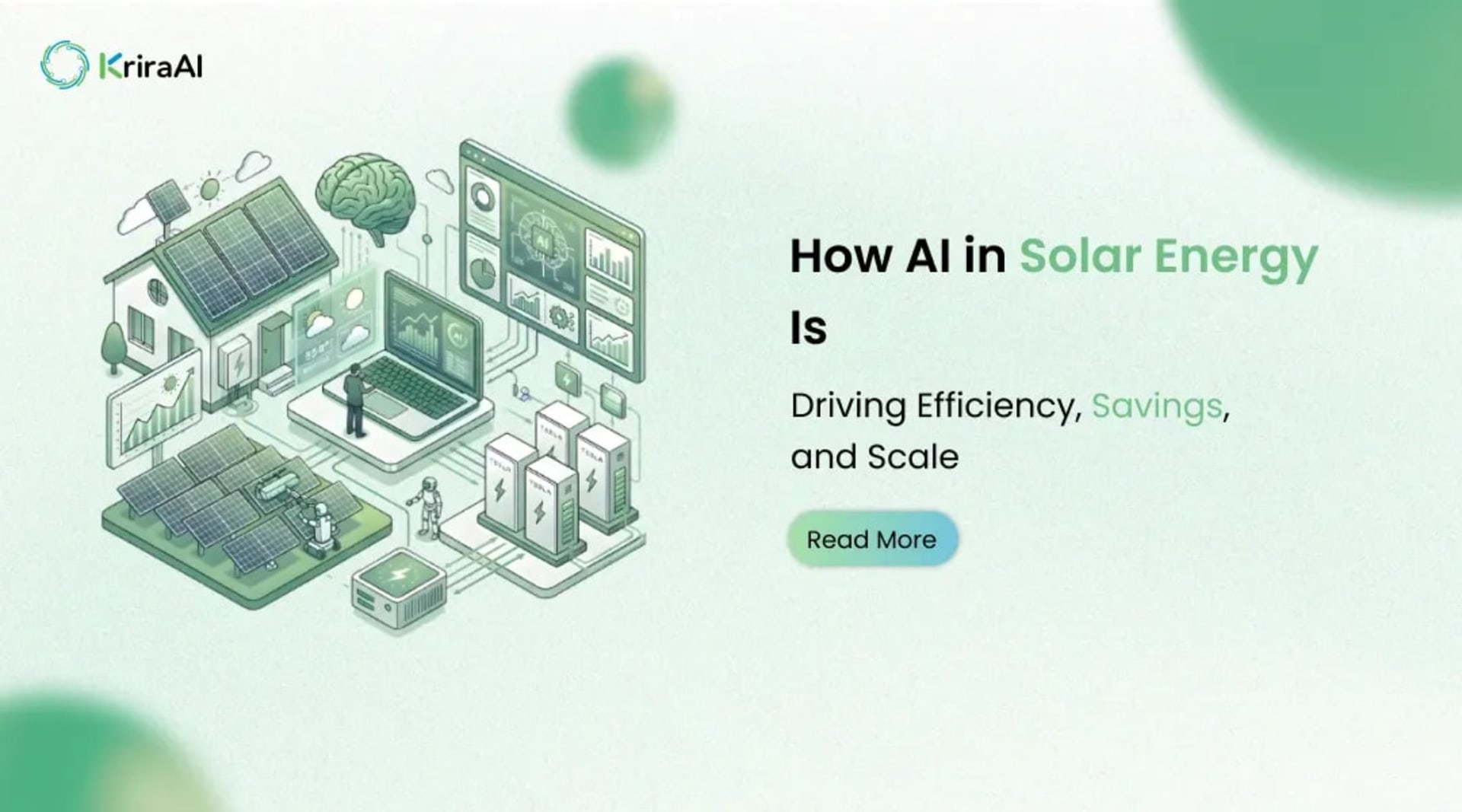
Solar energy is becoming increasingly digital. From utility-scale solar farms and distributed generation portfolios to commercial installations and solar-plus-storage systems, operators are managing more equipment, more data, and more operational variables than traditional processes can handle efficiently.
This is where AI in solar energy can create practical value.
Artificial intelligence can analyze equipment data, identify abnormal operating patterns, improve energy forecasting, automate visual inspections, optimize maintenance planning, and support better decisions across the solar asset lifecycle.
Instead of treating solar operations as a collection of disconnected systems, AI can bring together information from inverters, sensors, weather data, maintenance records, satellite imagery, inspection images, and other operational sources to produce actionable insights.
For solar businesses exploring AI development services, the opportunity is not simply to add AI to an existing workflow. The larger opportunity is to use AI where better prediction, automation, and optimization can improve asset performance and operational decision-making.
This guide explains how AI is being used in solar energy, the most practical use cases, the technologies behind them, implementation challenges, and how businesses can approach solar AI projects.
What Is AI in Solar Energy?
AI in solar energy refers to the use of machine learning, computer vision, predictive analytics, optimization models, and other artificial intelligence technologies to improve solar planning, monitoring, maintenance, forecasting, and energy management.
The technology can be applied across different stages of the solar lifecycle.
During project development, AI can assist with site analysis, energy-yield estimation, satellite-image analysis, and design workflows.
During operations, AI can help identify equipment anomalies, monitor asset performance, analyze inspection imagery, forecast generation, and prioritize maintenance.
For solar-plus-storage systems, AI can also support decisions around battery charging, discharging, energy availability, and operational scheduling.
The right application depends on the type of solar asset, the data available, the operating environment, and the business objective.
Why Solar Operations Need AI
Solar assets generate large volumes of operational data.
A typical installation can produce information from:
Inverters
String monitors
Environmental sensors
Weather stations
Irradiance sensors
Power meters
SCADA systems
Maintenance systems
Drone inspections
Thermal imagery
Historical generation records
The challenge is not simply collecting this information.
The challenge is turning it into timely decisions.
Traditional monitoring systems can identify alarms and predefined thresholds, but they may not always capture complex relationships between equipment behavior, weather conditions, production levels, and degradation.
AI can add a layer of pattern recognition and prediction.
For example, a combination of temperature changes, power behavior, voltage variation, and historical operating conditions may indicate that an asset deserves closer inspection even when no single measurement has crossed a predefined threshold.
That makes AI particularly useful in environments where asset visibility and operational responsiveness matter.
How AI Is Used in Solar Energy
AI has several practical applications across the solar industry.
Predictive Maintenance for Solar Assets
Predictive maintenance uses machine learning and operational data to identify changes that may indicate developing equipment issues.
Models can analyze information such as:
Voltage and current behavior
Temperature
Vibration
Power output
Inverter performance
Equipment alarms
Historical maintenance records
Environmental conditions
The objective is to identify unusual patterns early enough for maintenance teams to investigate and plan intervention.
Predictive maintenance can be applied to inverters, trackers, transformers, motors, pumps, and other supporting infrastructure where meaningful data is available.
This approach can help solar operators move from purely scheduled or reactive maintenance toward more condition-based decision-making.
AI-Powered Solar Inspection
Inspecting large solar installations manually can be time-consuming.
Computer vision can help automate parts of the inspection process.
Drone-mounted RGB and thermal cameras can capture large volumes of visual data. AI models can then assist with identifying potential issues such as:
Hotspots
Cracks
Module damage
Soiling
Discoloration
Shading
Visible defects
Structural anomalies
Instead of requiring technicians to manually review every image, computer vision can prioritize areas that require closer attention.
Human inspection can remain part of the workflow, while AI reduces the amount of manual screening required.
Solar Energy Forecasting With AI
Solar generation is influenced by weather, irradiance, cloud cover, seasonality, historical performance, and local environmental conditions.
AI forecasting models can combine multiple data sources to estimate expected solar generation over future time periods.
Potential inputs include:
Historical generation data
Weather forecasts
Satellite imagery
Irradiance measurements
Temperature
Cloud conditions
Wind conditions
Site-specific operating data
More reliable forecasting can help operators plan maintenance, manage grid commitments, optimize storage, and make better operational decisions.
Forecasting should be treated as a probabilistic prediction problem rather than a guaranteed output estimate. Performance varies depending on location, forecast horizon, data quality, and model design.
AI for Solar Performance Monitoring
AI can continuously compare expected and observed performance.
For example, a system can establish a baseline for an asset or group of assets and identify meaningful deviations over time.
This can help teams investigate:
Unexpected generation drops
Underperforming strings
Inverter abnormalities
Repeated alarms
Performance degradation
Weather-related anomalies
Operational inefficiencies
The goal is to move from simply displaying data to identifying what deserves attention.
AI for Solar Site Selection and Planning
AI can also be applied before a solar installation becomes operational.
Machine learning and computer vision can process large datasets associated with:
Satellite imagery
Land characteristics
Solar irradiance
Weather conditions
Topography
Shading
Infrastructure availability
Historical environmental data
These tools can help project teams evaluate potential sites, identify constraints, estimate expected generation, and accelerate parts of the planning process.
AI does not replace engineering analysis or regulatory assessment, but it can help teams process complex information faster and identify promising opportunities.
AI for Solar Panel and System Optimization
Solar performance can vary because of tracking configuration, soiling, temperature, shading, equipment condition, weather, and other operational factors.
AI-based optimization systems can analyze these variables to identify opportunities to improve effective energy output.
Possible applications include:
Cleaning Optimization
AI can combine soiling information, environmental conditions, historical performance, and cleaning costs to help determine when cleaning may have the greatest operational value.
Tracking Optimization
Machine learning and optimization models can support tracking decisions based on site conditions and expected energy production.
Inverter Optimization
AI can monitor inverter behavior and identify operating patterns that may require attention or adjustment.
Asset Prioritization
AI can rank assets according to performance deviation, risk, or operational impact so teams can focus attention where it matters most.
AI for Solar Plus Storage
Solar and battery storage increasingly operate as integrated energy systems.
AI can support decisions involving:
Battery charging
Battery discharging
Solar curtailment
Energy forecasting
Load conditions
Market signals
Operational constraints
Energy availability
Instead of treating the solar plant and battery as separate systems, AI can help coordinate them according to operational objectives.
The appropriate optimization strategy depends on the market structure, storage technology, site configuration, contractual requirements, and available data.
Key Technologies Behind Solar AI Solutions
AI in solar energy typically combines several technologies rather than relying on a single model.
Machine Learning
Machine learning can support anomaly detection, prediction, classification, forecasting, and optimization.
The appropriate model depends on the available data and the specific business problem.
Computer Vision
Computer vision can analyze RGB, thermal, aerial, or other visual data for automated inspection and defect detection.
Time-Series Analytics
Solar assets generate continuous streams of operational data. Time-series techniques help identify trends, seasonality, changes, and unusual patterns.
Digital Twins
Digital twins can provide a digital representation of assets or systems for monitoring, analysis, simulation, and optimization.
IoT and Industrial Connectivity
Sensors and connected equipment provide the data layer required for continuous monitoring and AI-driven analysis.
Data Engineering and MLOps
A successful solar AI platform also needs reliable data pipelines, model monitoring, deployment processes, version control, and retraining workflows.
The AI model is only one part of the solution.
Benefits of AI in Solar Energy
When correctly implemented, AI can help solar businesses improve several areas of operations.
Better Equipment Visibility
AI can analyze data from multiple systems and surface patterns that may otherwise remain hidden in operational records.
Earlier Issue Detection
Anomaly detection and predictive models can help identify developing issues earlier than purely reactive workflows.
More Efficient Inspections
Computer vision can prioritize images and locations that require human review.
Improved Forecasting
AI-based forecasting can support planning around expected solar generation and changing environmental conditions.
Smarter Maintenance Planning
Maintenance teams can use asset-health information and risk signals to prioritize work.
Operational Scalability
Automation becomes increasingly valuable as solar portfolios grow and the number of monitored assets increases.
Better Use of Operational Data
AI can transform large quantities of raw equipment and environmental data into decision-support information.
AI in Solar Energy: Implementation Challenges
AI can create significant value, but implementation requires more than selecting a model.
Data Quality
Inconsistent, missing, noisy, or poorly labeled data can affect model performance.
Solar businesses should evaluate data quality before beginning model development.
Legacy Systems
Older installations may use different SCADA platforms, communication protocols, inverter technologies, or monitoring systems.
Integration can therefore become a major part of the project.
Limited Failure Data
Solar operators may have a large amount of normal operating data but relatively few well-documented failure events.
This can make supervised predictive modeling difficult and may increase the value of anomaly detection or hybrid approaches.
Site-Specific Conditions
A model trained for one geographic environment may not perform equally well at another site.
Differences in climate, equipment, soiling, operating behavior, and environmental conditions need to be considered.
Human Adoption
AI recommendations still need to fit real workflows.
Field and operations teams need understandable alerts, useful prioritization, and clear context.
A technically accurate model is not enough if operators do not trust or use its output.
Cybersecurity and Compliance
Connected operational technology introduces security considerations.
AI systems should be designed with appropriate access controls, data protection, monitoring, and integration safeguards based on the environment in which they operate.
How to Implement AI in Solar Energy
A phased approach can reduce implementation risk.
Step 1: Define the Business Problem
Start with a clear operational objective.
Examples include:
Reduce unplanned equipment downtime
Improve inspection efficiency
Improve generation forecasting
Identify underperforming assets
Optimize maintenance scheduling
Improve storage dispatch decisions
Step 2: Audit the Available Data
Identify the data generated by:
SCADA
Inverters
Sensors
Weather systems
Maintenance platforms
Inspection workflows
Historical generation records
Evaluate completeness, consistency, accessibility, and historical coverage.
Step 3: Select a Focused Pilot
Start with one use case rather than attempting to automate every part of solar operations at once.
A focused pilot makes it easier to establish measurable success criteria.
Step 4: Develop and Validate the AI Model
Prepare the data, develop the model, and validate predictions against historical or controlled operational outcomes.
Model performance should be measured using metrics appropriate to the specific use case.
Step 5: Integrate With Operational Systems
Connect AI outputs to dashboards, maintenance systems, alerts, or workflows already used by the operations team.
Step 6: Monitor Performance
Track model accuracy, false alerts, data drift, changing equipment behavior, and user feedback.
Step 7: Scale Across the Portfolio
Once the pilot demonstrates practical value, expand the solution to additional assets, sites, or operational processes.
How KriraAI Can Support Solar AI Development
KriraAI develops custom AI solutions around the data, systems, workflows, and goals of each business.
Our AI development services can support areas such as machine learning, predictive analytics, computer vision, data engineering, AI integration, and deployment.
For organizations operating solar infrastructure, a custom solution can connect data from existing systems and turn it into operational intelligence without requiring the entire technology environment to be replaced.
The implementation may include data preparation, model development, system integration, dashboards, monitoring, and ongoing optimization.
For a detailed implementation example, explore the AI solutions for the solar energy case study.
The Role of AI in the Future of Solar Energy
As solar portfolios become larger and more connected, the value of automated analysis is likely to increase.
Future solar AI systems can bring together:
Predictive maintenance
Computer vision inspection
Generation forecasting
Energy optimization
Digital twins
Battery management
Automated anomaly detection
Portfolio-level asset intelligence
The long-term opportunity is not simply to automate isolated tasks.
It is to create connected systems where data from across the solar asset lifecycle can support faster and more informed decisions.
At the same time, successful deployment will continue to depend on data quality, cybersecurity, system integration, domain expertise, and human oversight.
Conclusion
AI in solar energy can help operators turn growing volumes of equipment, environmental, and operational data into useful decisions.
From predictive maintenance and automated inspections to forecasting, performance monitoring, site analysis, and storage optimization, AI can support multiple stages of the solar lifecycle.
The most effective implementations begin with a clearly defined business problem and a realistic understanding of the available data. A focused pilot can then be used to validate the technology, measure business impact, and establish a foundation for broader deployment.
For solar companies, AI should not be approached as a standalone technology project. It should be connected to the operational processes that determine asset performance, maintenance efficiency, energy output, and long-term scalability.
KriraAI helps businesses build custom AI solutions designed around real operational requirements, existing technology environments, and measurable business objectives.
FAQs
Answers to the questions enterprises ask us most about building, pricing and running custom AI.
AI is used for predictive maintenance, solar forecasting, automated inspection, asset monitoring, site analysis, performance optimization, and energy management. The exact application depends on the type of solar asset and the available data.
AI can help improve effective energy output by identifying underperforming assets, supporting maintenance decisions, optimizing operational parameters, and improving forecasting. The actual impact depends on site conditions, equipment, data quality, and implementation.
Predictive maintenance uses equipment and operational data to identify abnormal patterns that may indicate developing faults. Maintenance teams can then investigate and prioritize intervention based on asset condition and risk.
Yes. Computer vision models can analyze RGB and thermal images to help identify potential defects, hotspots, soiling, cracks, shading, and other abnormalities.
Yes. AI models can combine historical generation data with weather, irradiance, satellite, and site-specific information to estimate future solar output. Forecast quality varies by location, time horizon, data quality, and model design.
AI solutions can often integrate with existing SCADA, inverter, sensor, monitoring, and maintenance systems. The exact integration approach depends on the architecture, protocols, data accessibility, and security requirements.
Yes. AI can support generation forecasting, battery charge and discharge planning, asset monitoring, and operational optimization for solar-plus-storage environments.
Start with one measurable business problem, audit the available data, select a focused pilot, and define success metrics before scaling the solution to additional assets or sites.
Founder & CEO
Divyang Mandani is the CEO of KriraAI, driving innovative AI and IT solutions with a focus on transformative technology, ethical AI, and impactful digital strategies for businesses worldwide.
Ready to Write Your Success Story?
Do not wait for tomorrow; lets start building your future today. Get in touch with KriraAI and unlock a world of possibilities for your business. Your digital journey begins here - with KriraAI, where innovation knows no bounds.