
The Role of AI Services in Digital Transformation
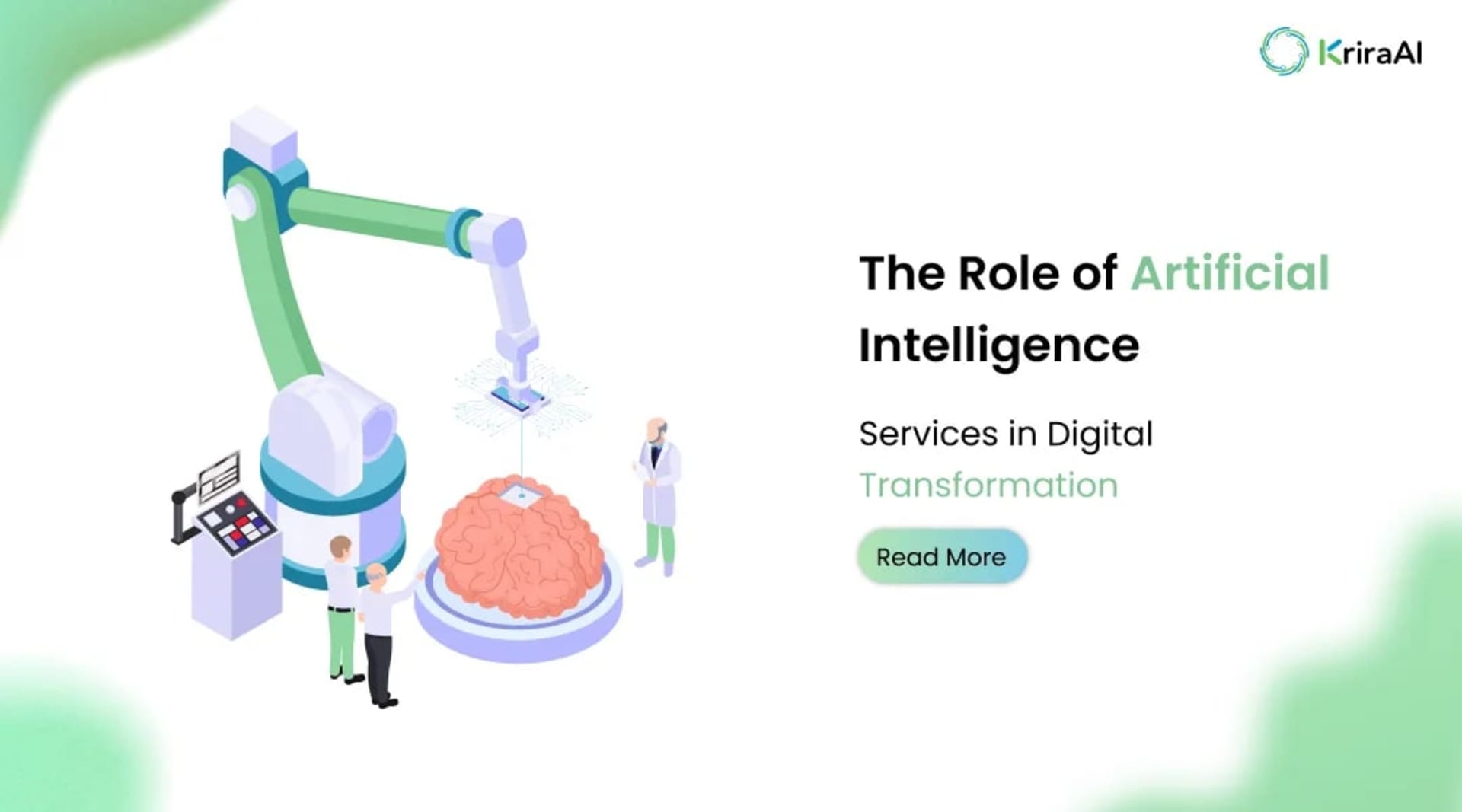
Digital transformation is no longer limited to moving paper-based processes online, replacing legacy software, or migrating systems to the cloud.
For many businesses, the next stage is making those digital systems more intelligent.
Artificial intelligence can help organizations analyze complex data, automate repetitive work, predict business outcomes, personalize customer experiences, and support faster decisions. This is why AI services in digital transformation are becoming increasingly important for businesses building modern digital operations.
However, adopting AI does not automatically create transformation. The technology needs to solve a specific business problem, integrate with existing systems, and produce measurable operational or customer value.
This article explains where AI fits into digital transformation, what business capabilities it can improve, and how organizations can approach AI adoption practically.
What Is Digital Transformation?
Digital transformation is the process of using digital technologies to improve how a business operates, serves customers, manages information, and creates value.
It can include:
Modernizing legacy applications
Moving workloads to cloud infrastructure
Digitizing manual processes
Connecting business systems
Improving data accessibility
Automating workflows
Creating digital customer experiences
Using analytics for better decisions
AI adds another layer to this transformation.
Instead of digital systems simply storing, transferring, or displaying information, AI can help those systems interpret information, identify patterns, generate predictions, and support actions.
What Role Does AI Play in Digital Transformation?
The role of AI in digital transformation can be understood across several business capabilities.
Intelligent Process Automation
Traditional automation follows predefined rules.
AI-enabled automation can handle situations where the input is less structured or requires interpretation.
For example, a business may use AI to process documents, classify customer requests, extract information from invoices, analyze conversations, or route cases according to their content.
This creates opportunities to automate processes that were previously dependent on manual review.
Predictive Analytics
Digital transformation generates large volumes of operational and customer data.
AI can analyze historical and real-time information to identify patterns and support predictions.
Businesses can apply predictive systems to areas such as:
Demand forecasting
Customer churn
Fraud detection
Equipment failure
Inventory planning
Sales forecasting
Risk assessment
Predictive analytics can help organizations move from simply reporting what happened to preparing for what may happen next.
Better Customer Experiences
Digital transformation has raised customer expectations.
Customers increasingly expect fast responses, relevant recommendations, convenient digital interactions, and consistent experiences across channels.
AI can support these expectations through:
Recommendation systems
AI-powered search
Conversational assistants
Personalized content
Customer intent analysis
Automated support
Behavioral prediction
The objective is not to add AI to every customer interaction. It is to use AI where intelligent interpretation can make the experience more useful or efficient.
How AI Services Support Business Transformation
Organizations rarely need only an AI model.
They often need a complete solution that connects AI capabilities with their existing technology environment.
This is where AI services can contribute to digital transformation.
AI Strategy and Consulting
Before building a solution, businesses need to identify where AI can create practical value.
AI consulting can help organizations assess:
Existing systems
Available data
Business processes
Automation opportunities
Technology constraints
Security requirements
Potential AI use cases
Implementation priorities
A clear roadmap helps avoid investing in AI projects that are technically interesting but commercially unnecessary.
Custom AI Software Development
Once a suitable use case is identified, businesses may need a custom application around the AI capability.
For example, a predictive model may need to connect with an existing ERP system. A document intelligence solution may need to integrate with workflow software. A customer-facing AI assistant may need access to approved business knowledge.
Custom AI software development connects the intelligence layer with the actual business process.
Machine Learning Development
Machine learning can support transformation when businesses need systems that learn patterns from historical or real-time data.
Applications can include classification, prediction, anomaly detection, recommendations, and forecasting.
Generative AI
Generative AI expands the number of tasks that can be supported through natural language, documents, images, and other content.
Enterprise applications can include:
Internal knowledge assistants
Document summarization
Content workflows
Enterprise search
Customer support
Report generation
Knowledge retrieval
Generative AI becomes more valuable when it is connected to controlled business data and real workflows rather than being used as a standalone chatbot.
AI Agent Development
AI agents can support workflows that require multiple steps, decisions, tool usage, and interaction with business systems.
Potential applications include:
Lead qualification
Customer support workflows
Internal task automation
Appointment scheduling
Research workflows
Operations assistance
Knowledge retrieval
Businesses should define clear permissions, escalation paths, monitoring, and human oversight for agent-based systems.
Key Benefits of AI in Digital Transformation
AI can contribute to digital transformation in several practical ways.
Increased Operational Efficiency
AI can reduce manual work in repetitive processes and allow teams to focus on tasks that require human judgment or domain expertise.
Faster Decision-Making
AI systems can process large amounts of information and surface relevant patterns or predictions faster than manual analysis alone.
Improved Customer Service
Conversational AI, intelligent routing, and automated workflows can help organizations handle customer requests more efficiently.
Better Forecasting
AI can support forecasting for areas such as demand, customer behavior, inventory, and operational risks.
Personalized Experiences
Customer data can be analyzed to provide more relevant recommendations, offers, and interactions.
Scalable Operations
Once properly integrated, AI-enabled workflows can support increasing transaction volumes without requiring every process to scale linearly with additional manual effort.
AI Use Cases Across Industries
The role of AI in digital transformation differs by industry because every business has different data, workflows, and regulatory requirements.
Healthcare
AI can support clinical documentation, patient engagement, medical image analysis, administrative workflows, and predictive applications.
Finance
Financial organizations can use AI for fraud detection, risk analysis, customer service, document processing, and compliance-related workflows.
Manufacturing
Manufacturers can apply AI to predictive maintenance, visual inspection, production optimization, demand forecasting, and quality management.
Retail
Retail businesses can use AI for recommendations, demand forecasting, inventory intelligence, customer segmentation, visual search, and personalization.
Logistics
AI can support route planning, demand forecasting, shipment analysis, warehouse operations, and anomaly detection.
Education
Education providers can use AI for learning personalization, student support, document processing, content assistance, and administrative automation.
AI and Legacy Systems
One of the biggest challenges in digital transformation is that businesses rarely start with a clean technology environment.
Many organizations have:
Legacy applications
Multiple databases
Older APIs
Manual spreadsheets
Disconnected SaaS platforms
On-premise systems
Inconsistent data formats
Replacing everything is rarely practical.
Instead, AI can be introduced as an additional intelligence layer that works with existing systems through APIs, integration platforms, data pipelines, and carefully designed application architecture.
This allows organizations to modernize incrementally rather than attempting a complete technology replacement.
Challenges Businesses Should Consider
AI can create significant opportunities, but implementation also requires careful planning.
Data Quality
AI systems depend heavily on the quality and relevance of their data. Incomplete, inconsistent, outdated, or biased data can affect results.
Security and Privacy
Sensitive business and customer information needs appropriate access controls, security measures, and governance.
Integration Complexity
A successful AI prototype still needs to work with real applications, APIs, databases, workflows, and user interfaces.
Model Performance
AI systems should be evaluated using defined metrics rather than assumptions about accuracy or effectiveness.
Cost and Infrastructure
Model training, inference, data processing, storage, and monitoring all contribute to the total cost of an AI solution.
Change Management
Employees need to understand how AI changes workflows, responsibilities, and decision-making processes.
Human Oversight
For high-impact business processes, organizations should establish appropriate review, escalation, and control mechanisms.
How to Build an AI Digital Transformation Strategy
A practical AI transformation strategy can follow a structured approach.
1. Identify High-Value Business Problems
Start with operational or customer problems rather than technology trends.
Ask:
What process is inefficient?
Where does manual work consume significant time?
Which decisions depend on large amounts of data?
Where are customers experiencing friction?
Which business risks are difficult to predict?
2. Assess Data Readiness
Determine what data exists, where it is stored, how it is accessed, and whether it is suitable for the intended use case.
3. Prioritize AI Use Cases
Not every possible AI idea should become a project.
Prioritize use cases based on:
Business impact
Technical feasibility
Data availability
Implementation complexity
Security requirements
Expected return
4. Build a Focused Pilot
A focused proof of concept or production pilot can help validate assumptions before the organization expands the investment.
5. Integrate With Existing Workflows
AI should become part of the user's actual workflow rather than another disconnected tool.
6. Measure Results
Define success metrics before deployment.
Depending on the use case, these could include:
Processing time
Accuracy
Conversion rate
Manual effort
Response time
Error rate
Customer satisfaction
Operational cost
7. Scale Carefully
Once the use case demonstrates value, the organization can expand the solution to additional teams, workflows, or business units.
AI Transformation vs Traditional Automation
AI and automation are related, but they are not the same.
Traditional automation works well when processes can be clearly defined with predictable rules.
AI is useful when systems need to interpret complex information, recognize patterns, make predictions, or work with unstructured data.
For example:
Traditional automation:
When an order is approved, automatically send a confirmation email.
AI-enabled automation:
Analyze an incoming customer message, determine the intent, classify the request, retrieve relevant information, and route or respond according to the business workflow.
Businesses can use both approaches together.
The most effective digital transformation programs often combine conventional automation with AI where intelligent interpretation provides additional value.
How Businesses Should Evaluate an AI Services Partner
The technology provider you choose can significantly affect the success of an AI transformation project.
Look for a partner that understands both technology and business processes.
Important areas to evaluate include:
AI and machine learning expertise
Software engineering capabilities
System integration experience
Data engineering knowledge
Security practices
Testing and monitoring
Deployment capabilities
Post-launch support
Ability to understand industry-specific requirements
A strong partner should explain how the solution fits your architecture and business processes, not simply recommend a model or AI tool.
The Future of AI-Driven Digital Transformation
AI is becoming part of a broader digital technology ecosystem.
Businesses are increasingly combining:
Generative AI
AI agents
Machine learning
Computer vision
Natural language processing
Predictive analytics
Intelligent automation
Cloud infrastructure
Enterprise data platforms
The long-term opportunity is not simply to introduce more AI tools.
It is to build digital systems that can understand information, support decisions, automate appropriate tasks, and continuously improve business operations.
Conclusion
Artificial intelligence can play an important role in digital transformation by adding intelligence to the digital systems businesses already depend on.
From process automation and predictive analytics to personalization, intelligent search, customer service, and AI agents, the technology can support businesses in improving efficiency and making better use of their data.
But successful AI transformation does not begin with a model.
It begins with a business problem.
Organizations that define clear objectives, assess their data, select appropriate use cases, integrate AI into existing workflows, and measure outcomes are better positioned to turn AI investment into lasting business value.
For enterprises evaluating AI adoption, the goal should not be to use AI everywhere.
The goal should be to use AI where it can make the business meaningfully better.
FAQs
Answers to the questions enterprises ask us most about building, pricing and running custom AI.
AI adds intelligence to digital business systems by helping organizations automate processes, analyze data, identify patterns, make predictions, personalize customer experiences, and support faster decision-making.
AI services can support digital transformation through AI strategy and consulting, custom AI software development, machine learning, generative AI, AI agents, predictive analytics, and intelligent process automation. These services help connect AI capabilities with existing business systems and workflows.
The main benefits include increased operational efficiency, faster decision-making, improved customer service, better forecasting, personalized experiences, reduced manual effort, and more scalable business operations.
Common examples include predictive maintenance in manufacturing, fraud detection in finance, recommendation systems in retail, intelligent document processing, AI-powered customer support, demand forecasting, personalized learning, and automated business workflows.
Traditional automation generally follows predefined rules and workflows. AI can interpret unstructured information, recognize patterns, make predictions, and support decisions in situations where fixed rules may not be sufficient. Businesses can combine traditional automation and AI to improve digital processes.
Yes. AI can often be integrated with legacy systems through APIs, data pipelines, integration platforms, and custom software. This allows businesses to introduce AI as an additional intelligence layer without immediately replacing their entire technology infrastructure.
Founder & CEO
Divyang Mandani is the CEO of KriraAI, driving innovative AI and IT solutions with a focus on transformative technology, ethical AI, and impactful digital strategies for businesses worldwide.
Ready to Write Your Success Story?
Do not wait for tomorrow; lets start building your future today. Get in touch with KriraAI and unlock a world of possibilities for your business. Your digital journey begins here - with KriraAI, where innovation knows no bounds.